
Blog
Commercial Locksmith Services, Panic Bars and Card Access
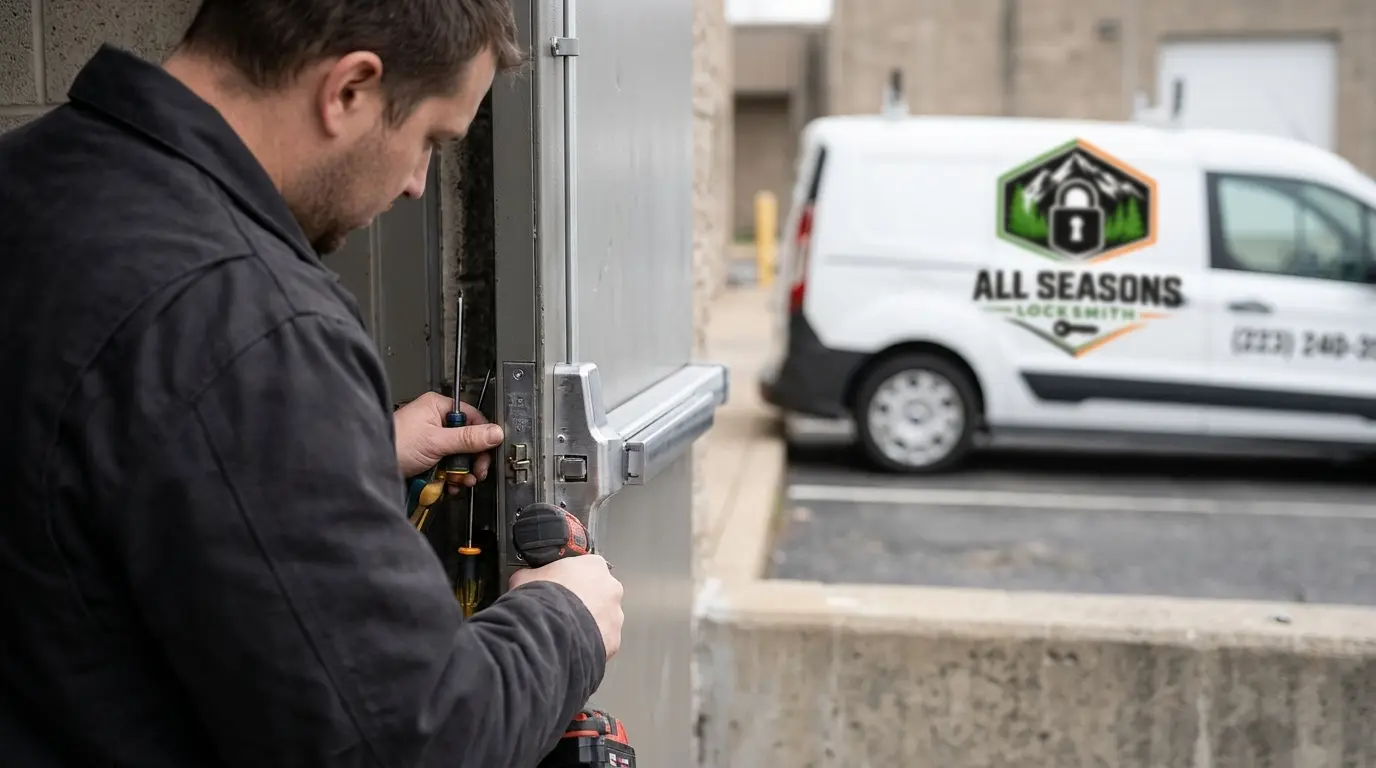
Which door hardware does a business actually need?
If you run a shop, office or warehouse in Central PA, commercial locksmith services mostly mean sorting your doors into three piles. Exits need panic bars. Interior doors work well on a master key system. The front entrance is a good fit for card access. We'd say nearly every problem we get called to traces back to one door doing two of those jobs at once.
Quick answer: Put every door in one of three roles: exit, key-managed or access-controlled. Exit doors must open from the inside without keys, tools or special knowledge. The other two roles can be tightened as far as the business wants.
What is a panic bar?
A panic bar, sometimes called exit hardware, is the push bar across the inside of a door. Lean on it and the latch lets go. Nobody has to hunt for a key or remember a code. They push and they're out.
Federal workplace rules back that up. An exit route door must be unlocked, and employees must be able to open it from the inside at all times without keys, tools or special knowledge. A panic bar that locks only from the outside is permitted on exit discharge doors (OSHA, 29 CFR 1910.36). So yes, a door can stay shut to the street and still open for anyone leaving.
What counts as an exit route, and why it matters for your doors
OSHA describes an exit route as a continuous, unobstructed path from any point in the workplace to a place of safety. It has three parts: the exit access, such as a corridor, then the exit itself, then the exit discharge, which is the last stretch that gets people outside (OSHA, 29 CFR 1910.34). Any door along that path is one where a mistake costs a lot.
Now think about your own building. Is there a back door that gets propped open on breaks? A stockroom door somebody chains at closing? A side door with a keyed deadbolt on the inside? Those are the doors an inspector notices, and honestly the ones we'd fix first.
What is a master key system?
A master key system lets one key open many locks while every lock keeps its own key too. The manager's key opens every office. A department key opens that department only. The front-desk key handles the front door and the supply room. Locks are set up in levels, so each person carries one key and not a ring.
We walk through the levels in our guide to signs your business needs a master key system. Short version: a master key system fits interior doors and tenant spaces best, where the goal is fewer keys and a clear record of who holds what.
How does card access differ from keys?
Card access, also called keyless entry, swaps the key for a card, fob or code. You can add or shut off each credential without touching the lock. When someone leaves, you deactivate their card in a few minutes, and nobody has to rekey a thing.
| Feature | Master key system | Card or fob access |
|---|---|---|
| What the user carries | A metal key | A card, fob or code |
| Losing a credential | Rekey or replace the affected locks | Deactivate that one credential |
| Record of who entered | None | Many systems keep an entry log |
| Best for | Interior doors, offices, tenant suites | Main entrances, shared areas, staff-only zones |
| Works with a panic bar | Yes, the bar still releases from inside | Yes, if installed to release from inside |
Card access doesn't replace exit hardware. The reader decides who comes in, while the panic bar decides how people get out. Our keyless entry systems page covers what we install.
The Door Role Check
Here's how we approach a building. It's a simple method we call the Door Role Check. Give every door one role before you shop for hardware.
- Walk the exit route. Begin at the farthest point of the building and trace the way out. Each door on that path is an exit door.
- Mark each exit door. It should open from the inside with one push or one lever. No key, no code, no second step.
- Mark the doors that need a key. Offices, storage and utility rooms usually belong on a master key system.
- Mark the doors that change often. Main entrances, shared hallways and employee-only zones are candidates for card access.
- Look for doors with two jobs. An exit door that's also supposed to be key-controlled is where problems begin. Fix those first.
| Door role | Hardware that fits | What to check |
|---|---|---|
| Exit | Panic bar | Opens from inside without a key, tool or special knowledge |
| Key-managed | Master key system | Key levels written down, key holders on a list |
| Access-controlled | Card, fob or code reader | A way to deactivate credentials, release from inside |
| Mixed | Panic bar plus outside control | Outside side controlled, inside side always free |
What goes wrong most often?
A few mistakes show up on almost every walkthrough.
- A chain or padlock on an exit door. It feels safer at night, but it defeats the purpose of the exit.
- A panic bar that doesn't latch. Worn hardware or a door that's out of square can leave it unsecured, or make it stick.
- Extra keys cut with no record. Within a year nobody can say how many copies are out there.
- A heavy exit door that never fully closes. A door closer solves that.
- A card reader with no release from inside. It controls who enters and traps whoever is trying to leave.
What happens during a commercial door review?
Plan on a short visit. We'll ask how many people work there, which doors staff use after dark, and where the spare keys live. Then it's exit route first, interior doors second.
At each door we check the hardware, how the door sits in the frame, whether the latch catches and whether the door closes on its own. We also note who holds keys today, and whether anyone still has one who shouldn't. You leave with a written list sorted by door role, so the exit doors get fixed first and the rest can be scheduled.
Doors that were changed over the years get extra attention. A bar bolted over an old lock, or a reader added with no release, is something we'll tell you to undo before we talk about anything new.
When to rekey, upgrade or add access control
If keys went missing or someone left on bad terms, commercial rekeying is the quick fix. Rekeying the same doors every year? Look at card access. Doors constantly propped open? That's usually worn hardware or a missing closer, so don't blame the crew.
For businesses in Harrisburg, Camp Hill, Mechanicsburg, Hershey and the towns around them, our commercial locksmith team walks the building, labels the door roles and writes up what each door needs before any work starts. You get the quote by phone before anything gets installed.
Frequently asked questions
What is the difference between a panic bar and a regular door lock?
A panic bar releases the door when someone pushes on it from inside, with no key or knob. A regular lock needs a key or a twist. Exit doors on a workplace route should open from inside without keys, tools or special knowledge.
Can I use a master key system and card access together?
Yes. Many buildings use card access on the main entrance and a master key system on interior doors. The exit doors keep their panic bars either way.
Can a card reader be used on an exit door?
It can control entry from outside, as long as the door still opens freely from inside. The release from inside is what matters.
How do I find a commercial locksmith near me in Harrisburg?
All Seasons Locksmith is a mobile service based in Harrisburg and covers Dauphin, Cumberland and Lebanon counties. Call (223) 240-3505 and describe the doors.
When can I call for commercial service?
Our hours are Sunday through Thursday, 7am to 10pm, and Friday 7am to 3:45pm. We are closed Saturday.
Need your doors reviewed?
We are bonded and insured, locally owned and operated, and we serve Harrisburg and the surrounding towns. Call (223) 240-3505 and ask for a commercial door review.
Sources: OSHA, "29 CFR 1910.36, Design and construction requirements for exit routes," retrieved 2026-11-09, osha.gov; OSHA, "29 CFR 1910.34, Coverage and definitions," retrieved 2026-11-09, osha.gov.
More from the blog
Business owners comparing options can also read our guide to signs your business needs a master key system, and our advice on choosing a locksmith you can trust.