
Blog
Rekeying a Commercial Property After an Employee Change
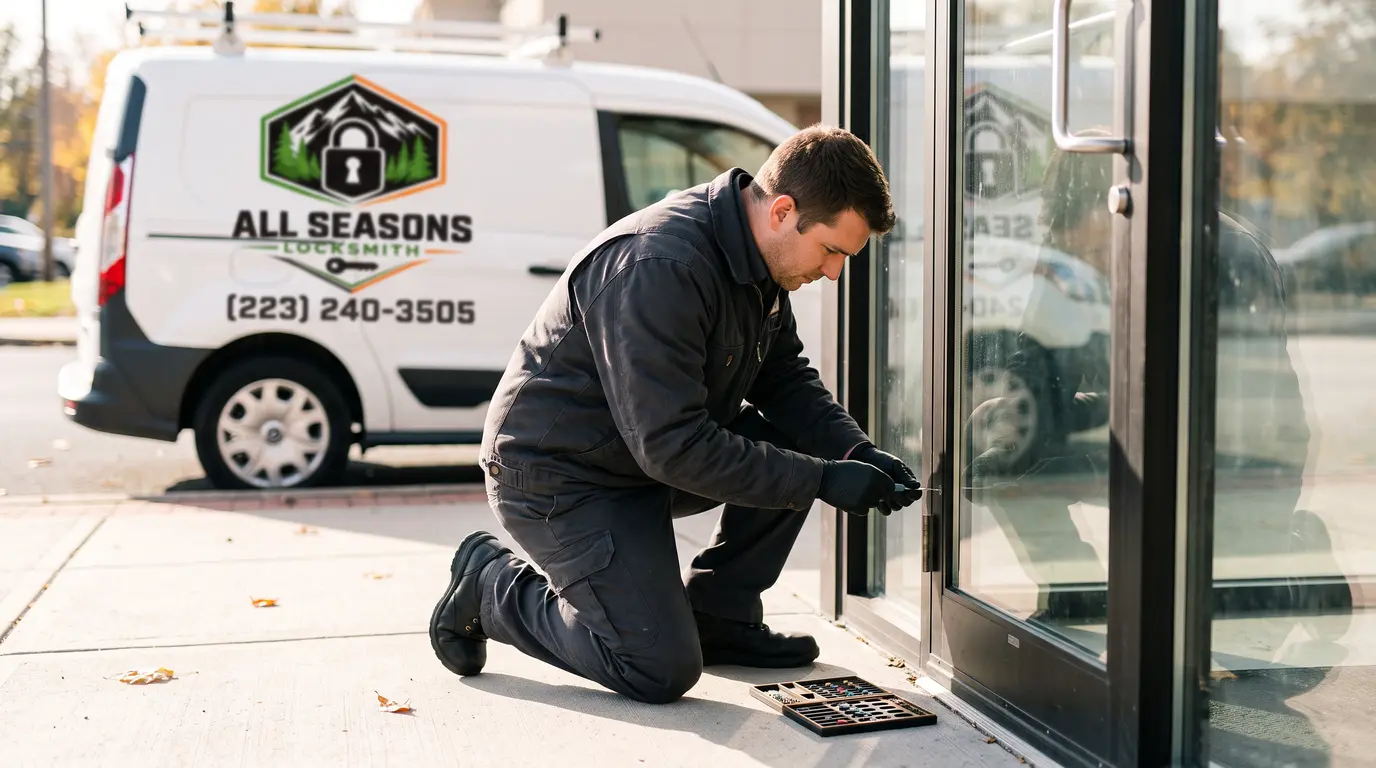
When does commercial rekeying make sense after someone leaves?
Say a shop manager gives two weeks' notice. On the last day you ask for the keys and get two of the three back. "I must have left the third at home," she says. Nice person, no bad intent, and you still don't know where that key is. That's the moment commercial rekeying earns its keep. It changes what's inside the lock so the old keys quit working, and the door keeps its hardware.
Quick answer: Count the keys that went out, find out how many came back, and rekey every door an unreturned key could open. Every key accounted for and the person left on good terms? A rekey is optional. One key unknown? Treat that door as open.
What does commercial rekeying actually change?
Pins. That's the short answer. Inside a cylinder there's a row of tiny ones, and the right key lifts each to the right height so the cylinder turns. We pull those pins and set new ones for a different key. Door, handle and lock body don't move.
Which is why it's the usual fix after a departure. Nobody's buying hardware for every door. You're only changing who can open it. Our commercial lock rekeying service handles cylinders, deadbolts and most commercial door hardware.
| Option | What changes | Good fit when |
|---|---|---|
| Rekey | The pins inside the cylinder | The hardware works fine and only the key holders changed |
| Replace the cylinder | The lock cylinder | A cylinder is worn, damaged or cannot be rekeyed |
| Replace the lock | The whole lockset | The hardware is failing, or you want a higher grade |
| Move to card access | The key becomes a credential | Turnover is constant and you want to switch credentials off |
Who counts as an employee change?
Wider than you'd think. Firings and resignations, obviously. But the seasonal worker whose contract ran out counts too, and so does the manager who transferred to your other site. The cleaner who borrowed a key for one project. The tenant who moved out of a shared building without a goodbye. Any of them might have had a copy made, and you'd never know.
WaterISAC put out a key control fact sheet for water utilities, and a lot of it applies to an ordinary shop. Its advice: revoke access as soon as someone separates or changes roles. Check the keys you've issued against your current roster. If extras are out there, get them back right away or treat them as lost (WaterISAC, Keys and Locks: The Overlooked Security Risk).
The Key Reconcile Check
Walk into a building after somebody has left and you'll hear the same thing. "We gave out a key, I think." Nobody has a list. So we ask owners to run a short routine on the day of the departure, and we call it the Key Reconcile Check.
- List every door that person could open. Front, back, stockroom, office, plus any gate or padlock.
- Write down every key they were given. Even a key stamped "Do Not Duplicate" may have been copied.
- Mark each key returned or not returned. "I think they gave it back" means not returned.
- Check whether the key sat on a master system. A master or sub-master opens far more doors than your list shows.
- Decide door by door. An unreturned or unknown key means that door gets rekeyed. Where every key came back, it's your call.
| Situation | Suggested action |
|---|---|
| All keys returned, left on good terms | Optional rekey, update the key list |
| One key not returned | Rekey every door that key opens |
| Left on bad terms, any doubt | Rekey the same day if you can, starting with exterior doors |
| Master or sub-master key unaccounted for | Rekey the whole system, which is a bigger job to plan |
| Keys were copied, count unknown | Rekey, then start a key log |
Which doors should you rekey first?
Exterior doors. They decide who gets in the building at all, so they go first. Then the interior doors in front of the cash drawer, the records room or the stock. A hallway door with nothing sensitive behind it? Give it a day or two.
A master key scrambles that order. It opens lots of cylinders, which puts the whole system at risk at once. Our guide to master key systems for multi-door businesses explains why one lost master is the hardest case to fix, and what a restructure looks like.
Rekey, replace or go keyless?
If the hardware is sound, rekey it. If a cylinder is worn, a bolt sticks, or the lock was never made for a business door, replace it. And if people keep coming and going, look at keyless entry systems. You can switch off a card or code in minutes. Nobody leaves with a metal key in their pocket.
One rule holds whichever way you go: exit doors still have to open from the inside. OSHA says employees must be able to open an exit route door from the inside at all times without keys, tools or special knowledge (OSHA, 29 CFR 1910.36). Rekeying controls who comes in from outside. It shouldn't make leaving harder. When an exit door needs hardware that releases freely from inside, a panic bar is the usual answer.
What happens during a commercial rekey visit?
We come to you, since the work is mobile. The visit goes like this.
- We confirm who can approve the work and which doors are included.
- We check that each cylinder can be rekeyed.
- We rekey the cylinders and cut the new keys.
- We try every lock with the new key, then try the old key to be sure it no longer turns.
- We hand you the keys with a written list of what opens what.
The quote comes by phone before we start. A small shop or office is often done in one visit, though the number of doors and the age of the hardware can change that.
How do you stop this from happening again?
Rekeying fixes today. A key log fixes next time. Keep a plain sheet: key number, who holds it, the day it went out, the day it came back. Give master keys to a few people you trust. Ask about restricted keys that a hardware store can't copy. And look at the list whenever your roster changes.
Not sure which approach suits your building? Our commercial locksmith team works in Harrisburg, Camp Hill, Mechanicsburg, Hershey and the towns nearby.
Frequently asked questions
Do I have to rekey every lock when an employee quits?
No. Rekey the doors that an unreturned or unknown key could open. If every key came back and the person left on good terms, a rekey is optional.
How long does commercial rekeying take?
It depends on the number of doors and the age of the hardware. A few doors are often finished in one visit. A full building or a master key system takes more planning.
Can a business rekey be done after hours?
We schedule around your business where we can. Our hours are Sunday through Thursday, 7am to 10pm, and Friday 7am to 3:45pm. We are closed Saturday.
Is rekeying better than changing the locks?
When the hardware is in good shape, yes. Rekeying changes the key without replacing the lock. Replacement makes sense when a lock is worn, damaged or too low grade for a business door.
Who do I call for commercial rekeying near Harrisburg?
All Seasons Locksmith is a mobile service based in Harrisburg and covers Dauphin, Cumberland and Lebanon counties. Call (223) 240-3505 and tell us how many doors are involved.
Need your business locks rekeyed?
All Seasons Locksmith is bonded and insured, locally owned and operated, and based at 1727 N 6th St STE 301, Harrisburg, PA 17102. Call (223) 240-3505 and we will walk through the doors with you and quote the job by phone.
Sources: WaterISAC, "Keys and Locks: The Overlooked Security Risk" fact sheet, retrieved 2026-11-16, waterisac.org; OSHA, 29 CFR 1910.36 Design and construction requirements for exit routes, retrieved 2026-11-16, osha.gov. Published 2026-11-20 by All Seasons Locksmith.
More from the blog
Rekeying is one part of door security. Our guide on whether to rekey after moving in covers the home side, and choosing an emergency locksmith you can trust explains how to vet a company before you call.