
Blog
What Central PA Drivers Should Know About Transponder Keys and Ignition Repair
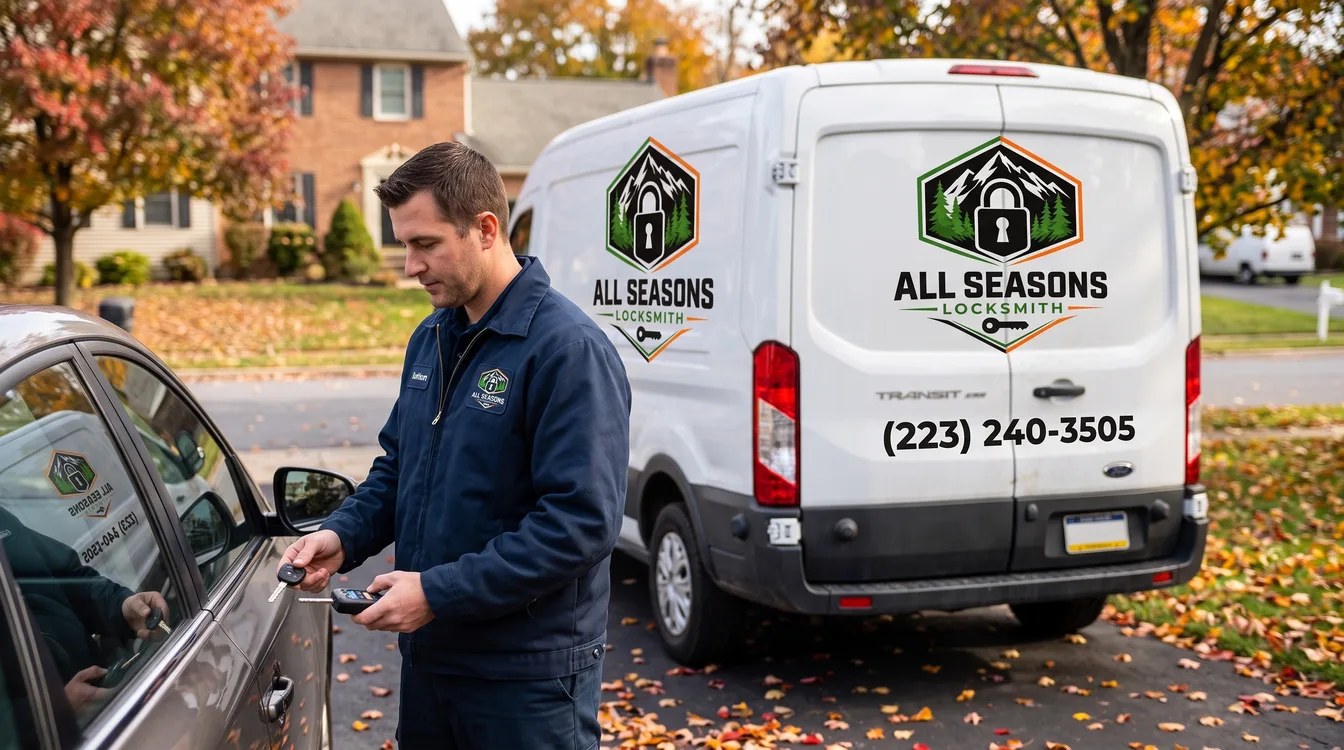
Key goes in, key turns, dash lights come on, and the engine just sits there. Annoying, and a little scary if you're running late. Nine times out of ten the cause is the chip in a transponder key, or a worn-out ignition. That chip is how the car decides whether a key is the real thing. Lose it, crack it, or never get it programmed, and the blade can fit the lock like a glove while the engine stays dead. A tired ignition causes trouble of its own, and the two get blamed for each other constantly. Keep reading and you'll know which one you're dealing with, plus what a mobile locksmith can fix without moving the car.
Quick answer: Key turns and the dash lights up, but the engine won't crank and a little key light blinks? Probably the chip. Key sticks, won't turn, or only works when you wiggle it? Probably the ignition cylinder. Either way, a locksmith can usually handle it at your car.
Table of contents
- What is a transponder key?
- How do you know if the transponder or the ignition is the problem?
- Why a copied key sometimes will not start the car
- What does ignition repair actually involve?
- Transponder key or ignition: a quick comparison
- What a locksmith needs before they arrive
- Frequently asked questions
What is a transponder key?
Inside the plastic head of the key sits a tiny microchip, smaller than a grain of rice. When the key gets close to the ignition, the car sends it a faint signal and the chip answers with its own unique code. The car's computer checks that code against what it expects. Per the Wikipedia article on immobilisers, the engine control unit reads that code, and if it doesn't recognize it, the unit won't let fuel flow or ignition happen.
That's the whole idea. The chip is an anti-theft layer, and it works. The U.S. Department of Justice's CrimeSolutions program rated an Australian engine immobilizer study "Effective", reporting a statistically significant reduction in theft of cars with immobilizers compared with cars without them, using theft data collected from 1990 through 2000. The feature that protects your car is also why a plain metal copy of your key won't start it.
Most cars built since the late 1990s use some version of this. Thick plastic head on your key? A fob with a blade folded in? Assume there's a chip inside.
How do you know if the transponder or the ignition is the problem?
Think about what the car did when you turned the key. The symptoms point different ways.
Signs of a transponder problem
- The key turns fine and the dash lights up, but the engine won't crank, or it fires and dies a second later.
- A little key, car or padlock symbol keeps blinking on the dash.
- This key worked yesterday. Today it doesn't, but the spare does.
- You just swapped the key's plastic shell, or picked up a copy at a hardware store.
Signs of an ignition cylinder problem
- The key is hard to push in, won't turn, or only turns if you wiggle it.
- The key won't come out, or only comes out in one position.
- The area around the key slot feels loose.
- Nothing at all happens when you turn the key, and the battery tests fine.
Here's the part most guides skip. A worn ignition can look just like a transponder problem, and the reverse happens too. So a good tech tests the key and the ignition separately before replacing anything. That one step keeps you from fixing the wrong part.
Why a copied key sometimes will not start the car
This catches a lot of drivers out. You had a spare cut, the blade turns in the lock, and the car still won't start.
Cutting a blade copies the shape of the key. It doesn't copy the chip's code. No programmed chip means the car sees a stranger. That's how a hardware store copy can open the door and still leave you stuck.
When we do a car key duplication, we cut the blade and program the chip during the same visit, so the copy starts the car. Lost every key? The car key replacement service makes and programs a new one from the vehicle's information, no towing needed.
Another one to rule out is a key shell swap. Say the shell cracks and someone moves the circuit board over but leaves the small glass chip behind. The key looks fine and the car won't start. The chip has to travel with the key.
What does ignition repair actually involve?
The ignition cylinder is the part of the lock your key slides into. It's full of tiny pins, and years of turning wear them down. A bent or beat-up key speeds that up. Once it gets rough or starts to stick, you're looking at repair or replacement.
| Situation | Typical fix | Done on site? |
|---|---|---|
| Key sticks, but cylinder is intact | Clean and repair the cylinder | Usually yes |
| Cylinder worn out or broken | Replace the cylinder and cut a matching key | Usually yes |
| Electrical switch behind the cylinder failed | Replace the ignition switch | Depends on the vehicle |
| Key will not come out | Diagnose cylinder wear or a stuck lock mechanism | Usually yes |
| Transponder key will not start after the work | Reprogram the key to the car | Yes |
Our ignition repair service handles cylinders that stick or turn rough. If one is beyond saving, ignition replacement swaps in a new cylinder and matches a key to it. We start with non-destructive methods, aim to finish in one visit, and quote you by phone before any work begins.
One more thing on timing. A rough ignition doesn't heal itself. If the key's getting harder to turn, deal with it before the morning it quits in a parking lot. Planned visits beat emergencies.
Transponder key or ignition: a quick comparison
| Question | Transponder problem | Ignition problem |
|---|---|---|
| Does the key turn? | Usually yes | Often no, or only with effort |
| Do the dash lights come on? | Yes | Sometimes not |
| Does the engine crank? | No, or starts then stalls | Often no |
| Is there a blinking security light? | Often yes | Rarely |
| Does a spare key behave the same? | A programmed spare often works | Spare also feels rough |
| Who fixes it? | Locksmith with programming equipment | Locksmith, repairing or replacing the cylinder |
What a locksmith needs before they arrive
When you're stuck, speed matters. Have these ready when you call:
- Year, make and model of the car.
- The VIN. Look at the bottom corner of the windshield on the driver's side, or the driver's door jamb.
- Your ID, plus the registration or title showing the car is yours.
- What the car actually does when you try to start it. Plain words are fine.
- Where it's parked. We drive to you in Harrisburg and across Dauphin, Cumberland and Lebanon counties.
A few vehicles, mainly some newer European models and 2018-and-newer Chrysler, Dodge, Jeep and RAM, sit behind extra security systems. Ask about your exact vehicle when you call. We'd rather tell you up front than burn your time. Our earlier post on locksmith or dealer for key fob programming covers which cars fall into that group. Not sure which service you need at all? Start with what determines your car key replacement options.
Frequently asked questions
Can a locksmith program a transponder key without the original key?
In most cases, yes, even with every key gone. The car's identification information is enough for a locksmith to cut a new key and pair it. Nobody has to tow anything.
Why does my car not start when the key turns?
Most often the car isn't recognizing the chip in the key. The usual suspects are a missing or damaged chip, a copy that was cut but never programmed, and a swapped key shell. Now and then a worn ignition is to blame instead. That's why we check both.
Is it the key or the ignition?
Key turns easily and a security light blinks? Think chip. Key sticks, won't turn or won't come out? Think ignition. A quick test on site settles it.
Can you fix a stuck car key in the ignition without damaging the steering column?
Usually. The repair is on the cylinder, and a careful tech leaves the column alone.
Do I need to take the car to a shop?
No. We come to you, whether the car is at home, at work or in a parking lot.
Need a transponder key or ignition looked at?
We're All Seasons Locksmith, bonded and insured, locally owned and operated, serving Harrisburg and Central Pennsylvania. Call (223) 240-3505, Sunday through Thursday 7am to 10pm or Friday 7am to 6pm. We are closed Saturday. Browse our automotive locksmith services or send a request through the site.
Sources: U.S. Department of Justice, CrimeSolutions, "Engine Immobilizers (Australia)," retrieved 2026-10-01, crimesolutions.ojp.gov; Wikipedia, "Immobiliser," retrieved 2026-10-01, en.wikipedia.org.